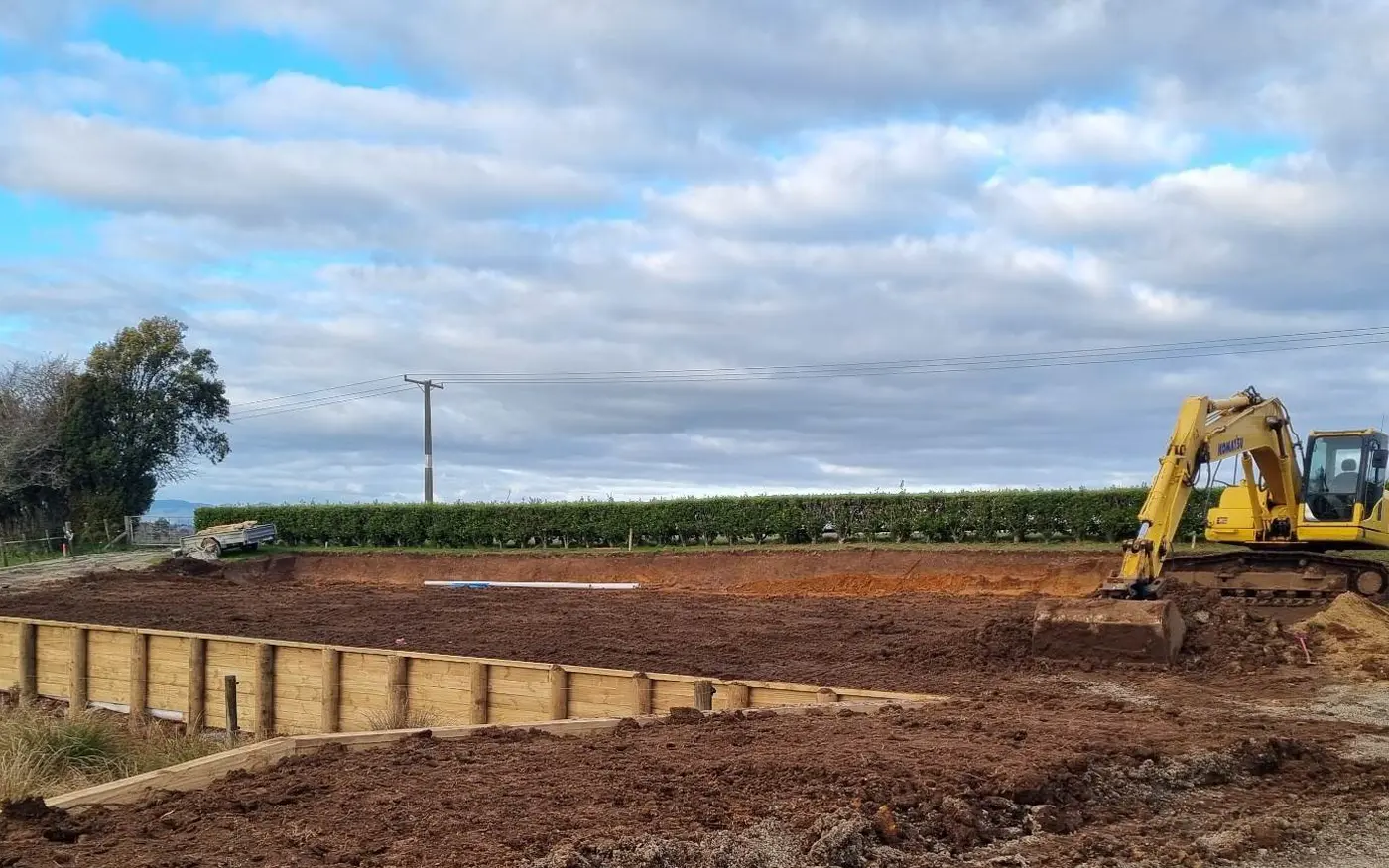
In short
- Whether earthworks need consent depends on volume, area, slope, zone and overlays.
- Limits are far lower in flood plains, overland flow paths, ecological, coastal and heritage overlays.
- Even permitted earthworks must control sediment and must not cause instability or flooding.
- Check the property on Auckland Council GeoMaps, then confirm with the council.
Earthworks in Auckland need a resource consent when they exceed the limits in the Auckland Unitary Plan for that property. Those limits depend on the volume of soil moved, the area disturbed, the slope of the land, the zone, and any overlays that apply. Many small residential jobs are permitted. The way to find out is to check the property on Auckland Council GeoMaps and confirm with the council before work starts.
What counts as earthworks
The Unitary Plan calls it land disturbance. It covers digging, filling, cutting, contouring and stockpiling, including work for building platforms, driveways, retaining walls, pools, landscaping and trenches. Cultivating a garden and digging post holes are not what the rules are aimed at. Both cut and fill count, and so does soil brought onto or taken off the site.
Two sets of rules
Two chapters of the Unitary Plan apply, and a job can trigger either or both.
- Regional rules (Chapter E11) are about sediment and water quality. They look mainly at the area of ground exposed and how steep it is, and at whether the site is in a sediment control protection area near a stream or the coast.
- District rules (Chapter E12) are about effects on neighbours and the land: stability, noise, dust, truck movements and changes to ground level. They set limits on area and volume for each zone.
The limits differ between residential, rural, business and open space zones, and they are amended from time to time, so this guide does not quote figures. Read the current tables on the council's website or ask a planner.
Overlays change everything
The zone limits apply only where no overlay sets a stricter one. In the following areas, the permitted amount is much smaller, and sometimes close to nothing.
| Overlay or feature | Why earthworks are restricted |
|---|---|
| Flood plain | Fill displaces floodwater onto other properties |
| Overland flow path | Blocking or diverting it moves flooding next door |
| Significant ecological area | Protects native bush, wetlands and habitat |
| Outstanding natural feature or landscape | Protects volcanic cones, lava fields and coastlines |
| Coastal erosion and instability areas | Cuts and loads can trigger slips |
| Historic heritage and special character | Protects sites, buildings and their settings |
| Notable trees | Root zones must not be dug or filled |
| Waitākere Ranges Heritage Area | Tight limits on clearing and land disturbance |
| Sites of significance to Mana Whenua | Protects wāhi tapu and cultural sites |
Streams, wetlands and the coast also have setbacks, and national freshwater rules restrict earthworks near natural wetlands.
How to check your property
- Open Auckland Council GeoMaps and search the address.
- Turn on the Unitary Plan layers. Note the zone and every overlay, control and designation over the site.
- Turn on the flood plain, overland flow path, flood-prone area and coastal inundation layers.
- Estimate your earthworks: area in square metres, volume in cubic metres of cut plus fill, and the deepest cut.
- Compare with the tables in Chapters E11 and E12, or send the details to the council's planning helpdesk or a planning consultant.
The property file and the title are worth reading too. Consent notices from the original subdivision often restrict earthworks on newer sections.
Standards that apply even without a consent
Permitted does not mean unregulated. Earthworks that need no consent must still meet general standards, including:
- erosion and sediment controls in place, in line with the council's GD05 guideline. See erosion and sediment control;
- no instability caused on the site or neighbouring land;
- no blocking or diverting of overland flow paths;
- no soil or mud tracked onto the road;
- work stopping if archaeological remains, kōiwi or artefacts are found, under the accidental discovery rule;
- construction noise and vibration within the plan's limits.
Building consent is separate
A resource consent is about effects on the environment. A building consent is about the structure. Excavation for a house is covered by the house's building consent. A retaining wall needs a building consent if it holds back more than 1.5 metres of ground or carries extra load such as a driveway or building. Work over or near public pipes needs approval from Auckland Council or Watercare, and a new vehicle crossing needs approval from Auckland Transport. A project can need all of these or none.
What a consent involves
An application normally includes plans showing existing and proposed ground levels, the volumes and areas, an erosion and sediment control plan, and an assessment of effects. Sloping, coastal and flood-prone sites also need a geotechnical or flood report. Budget $4,000 to $12,000 for the council deposit and a planner's time on a straightforward residential application, $2,500 to $5,000 for a geotechnical report and $1,500 to $4,000 for engineering design where needed. Simple, non-notified applications are commonly decided in one to three months, depending on how complete the application is and how many questions the council asks.
The earthworks season
Consented bulk earthworks in Auckland are generally limited to the period from 1 October to 30 April. Work outside that season needs the council's approval for winter works, with extra sediment controls. Plan design and consent over winter so the digging can start in spring.
If earthworks are done without consent
The council can issue an abatement notice stopping the work, require the land to be reinstated, issue infringement fines and, in serious cases, prosecute. Both the owner and the contractor can be liable. Unconsented fill also shows up when a property is sold or a later building consent is applied for. It is far cheaper to ask first. The contractor who visits your site can tell you whether a job looks likely to need consent, and the residential earthworks page explains how the work is staged.
Common questions
How much earth can I move without a resource consent in Auckland?
There is no single figure. The permitted volume and area depend on the zone and are much lower where overlays such as flood plains, ecological areas or heritage apply. Check the property on GeoMaps and confirm with Auckland Council.
Do I need consent to level my back yard?
Often not, for a small area on a plain residential site with no overlays. If the yard is in a flood plain or overland flow path, near protected trees or the coast, or the cut or fill is large, you may. Check before starting.
How long does an earthworks resource consent take?
A straightforward, non-notified application is commonly decided in one to three months. Preparing the plans and reports beforehand can take as long again.
Can earthworks be done in winter in Auckland?
Small permitted jobs can. Consented bulk earthworks are generally limited to 1 October to 30 April unless the council approves winter works.