In short
- Most concrete driveways on clay need a digout of 200 to 300 mm below finished level.
- All topsoil comes out, however deep it goes.
- GAP 65 builds depth, GAP 40 or GAP 20 finishes the base, each layer compacted.
- A digout with a compacted base is $45 to $95 per m² as a guide.
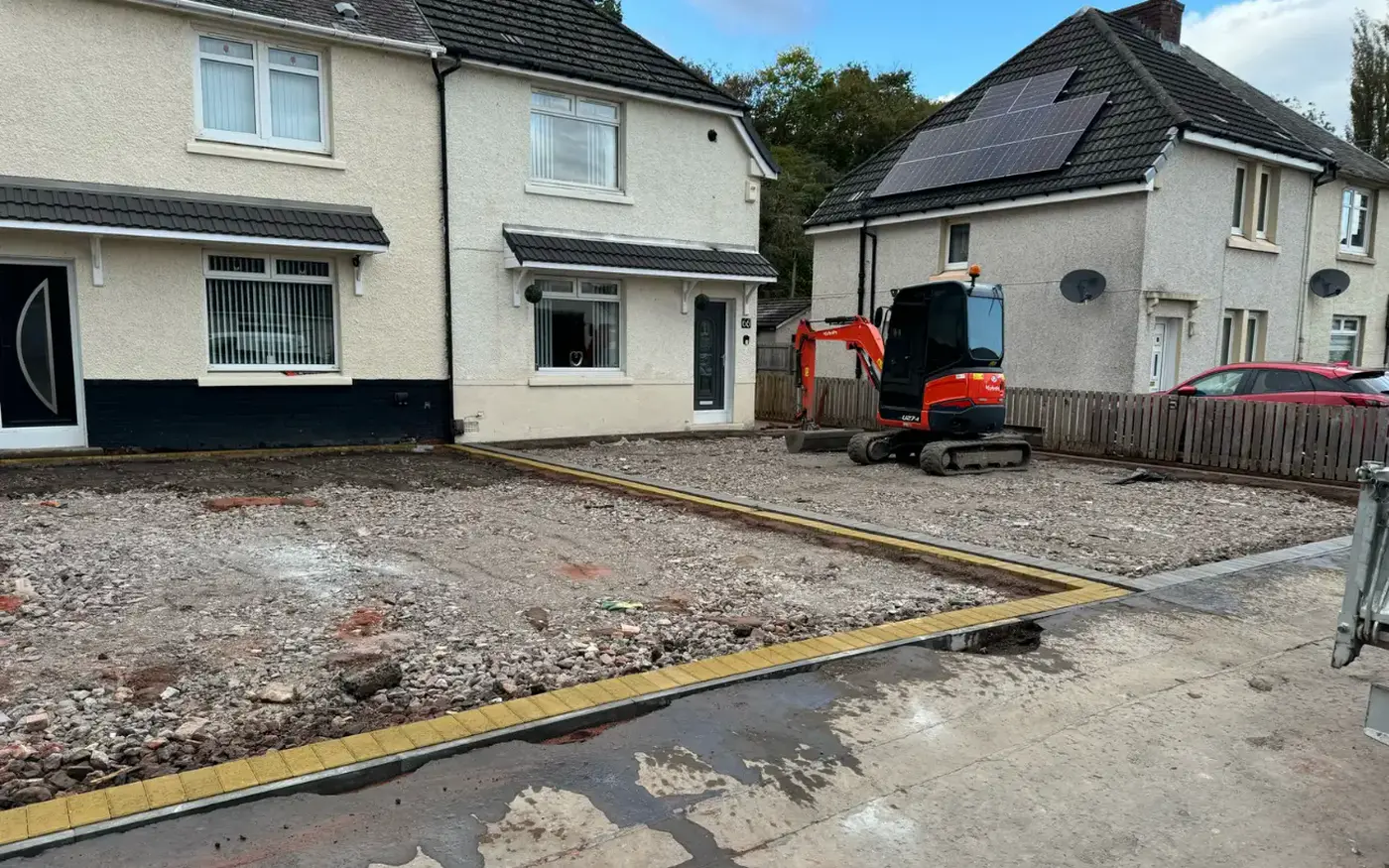
For a concrete driveway on Auckland clay, the usual digout is 200 to 300 mm below the finished surface: 100 to 125 mm for the concrete and 100 to 150 mm or more for the compacted base beneath it. Soft ground and heavy vehicles need more. Whatever the design depth, every bit of topsoil has to come out.
Working out the depth
Dig depth is simply the thickness of the surface plus the thickness of the base, measured down from the finished level. The finished level is fixed by the garage floor, the footpath and the falls needed for drainage. What varies is the base, and that depends on two things: how strong the ground is and what will drive on it.
| Driveway type | Surface | Compacted base | Typical digout |
|---|---|---|---|
| Concrete, cars only, firm clay | 100 mm | 100 to 150 mm | 200 to 250 mm |
| Concrete, light trucks or soft clay | 125 to 150 mm | 150 to 250 mm | 275 to 400 mm |
| Asphalt | 25 to 40 mm | 150 to 250 mm | 175 to 300 mm |
| Pavers | 50 to 80 mm plus bedding sand | 150 to 200 mm | 230 to 320 mm |
| Gravel or metal | Top course 50 mm | 150 to 250 mm | 200 to 300 mm |
Typical residential figures. An engineer or the concrete contractor sets the design for your site.
Why clay needs a proper base
Clay is strong when dry and weak when wet, and it swells and shrinks with the seasons. A slab poured straight onto it is supported unevenly: firm in February, soft in July. The base layer of crushed aggregate spreads wheel loads over a wider area, gives water somewhere to drain, and separates the concrete from the moving clay. Asphalt and pavers are flexible surfaces that rely on the base for all their strength, so they need more of it than concrete does.
GAP 65, GAP 40 and GAP 20
GAP stands for general all passing. The number is the largest stone size in millimetres, and the mix runs from that size down to dust, so it locks together when compacted.
- GAP 65 is coarse and used as a sub-base to build depth over soft ground.
- GAP 40 is the standard driveway basecourse.
- GAP 20 is finer and gives a smooth top to lay concrete, pavers or a gravel surface on.
Hardfill is a looser term for any compactable crushed rock or recycled concrete used to build up ground. Scoria is light and drains well but is weaker under load. Clean drainage metal, with no fines, is for drains and will not compact into a base.
How a digout is done
- Mark out and check services. Water, power, gas and fibre often cross the front of a section at shallow depth. Plans are requested through beforeUdig.
- Break out the old surface. Concrete and asphalt are lifted and sent for recycling.
- Dig to the design level. The digger cuts to depth and loads the truck. The bottom is shaped to the same falls as the finished surface.
- Proof the subgrade. Soft, wet or organic patches are dug deeper and backfilled with hardfill. Tree roots are cut back.
- Lay geotextile if needed. On soft clay, a fabric layer stops the stone punching down into the mud.
- Place and compact the base. Aggregate goes down in layers no thicker than about 150 mm, each one compacted with a roller or heavy plate until it stops moving underfoot.
- Trim to level. The surface is finished to within about 10 mm, ready for boxing.
Falls and drainage
A driveway is a large roof at ground level, and its runoff has to be controlled. The base and surface are given a fall of at least 1 in 100 toward a collection point. Where the drive slopes toward the garage, a channel drain goes across in front of the door. Runoff must be piped to an approved outlet and not sent across the footpath or into a neighbour's property. On sections that stay wet, a subsoil drain along the uphill edge keeps water out of the base.
Common mistakes
- Leaving topsoil in. It compresses and rots, and the slab cracks along the soft strip.
- Too thin a base on soft ground. Wheel ruts show within a year.
- Compacting only the top. A 300 mm layer rolled once is loose at the bottom.
- Backfilling service trenches with clay. The trench line settles and the concrete cracks above it. Trenches under a driveway are filled with compacted hardfill.
- Digging in the wet. Trafficking saturated clay destroys its strength, and the softened layer has to be dug out again.
The part outside your boundary
The vehicle crossing, between the kerb and your boundary, is on road reserve. In Auckland a new or altered crossing needs approval from Auckland Transport and has to be built to its standard for thickness, width and grade, by a contractor it accepts. Public pipes and street trees in the berm also limit what can be done. Confirm the requirements before the digout is priced.
What a digout costs
| Item | Guide price |
|---|---|
| Driveway digout and compacted base | $45 to $95 per m² |
| Break out and remove old concrete | $40 to $90 per m² |
| Imported hardfill, placed and compacted | $90 to $160 per m³ |
| Cart away and tip clean fill | $45 to $110 per m³ |
Guide prices for Auckland before GST, on a site with reasonable access. Only the written quote that follows a site visit is a firm figure.
For a 50 square metre driveway, the digout and base come to $2,250 to $4,750. Removing an existing concrete driveway first adds $2,000 to $4,500. Each extra 100 mm of depth on that area is another 5 cubic metres to dig and cart and 5 cubic metres of hardfill to buy, which is why the depth is worth getting right, not guessing high.
The service is described on the driveway excavation page and under digouts.
Common questions
How deep should I dig for a concrete driveway in NZ?
Typically 200 to 300 mm below the finished level on clay: 100 to 125 mm of concrete over 100 to 150 mm or more of compacted basecourse. Soft ground and heavier vehicles need a deeper base.
What is GAP 40?
A crushed aggregate graded from 40 mm stone down to fines. It compacts into a dense, stable layer and is the standard basecourse under driveways.
Do I need to remove all the topsoil?
Yes. Topsoil is soft and organic and will settle. It is removed under the whole driveway, even where that means digging deeper than the design depth.
Can I lay a new driveway over the old one?
Rarely with a good result. The old surface sets the levels too high and hides whatever caused it to fail. Removing it and rebuilding the base is the lasting fix.