In short
- A subsoil drain is a perforated pipe in a trench of clean drainage metal, wrapped in filter cloth.
- It lowers groundwater. It is not for roof water or surface floods.
- It needs a steady fall, access points for cleaning and a lawful outlet.
- Installed, it costs $90 to $200 per metre as a guide.
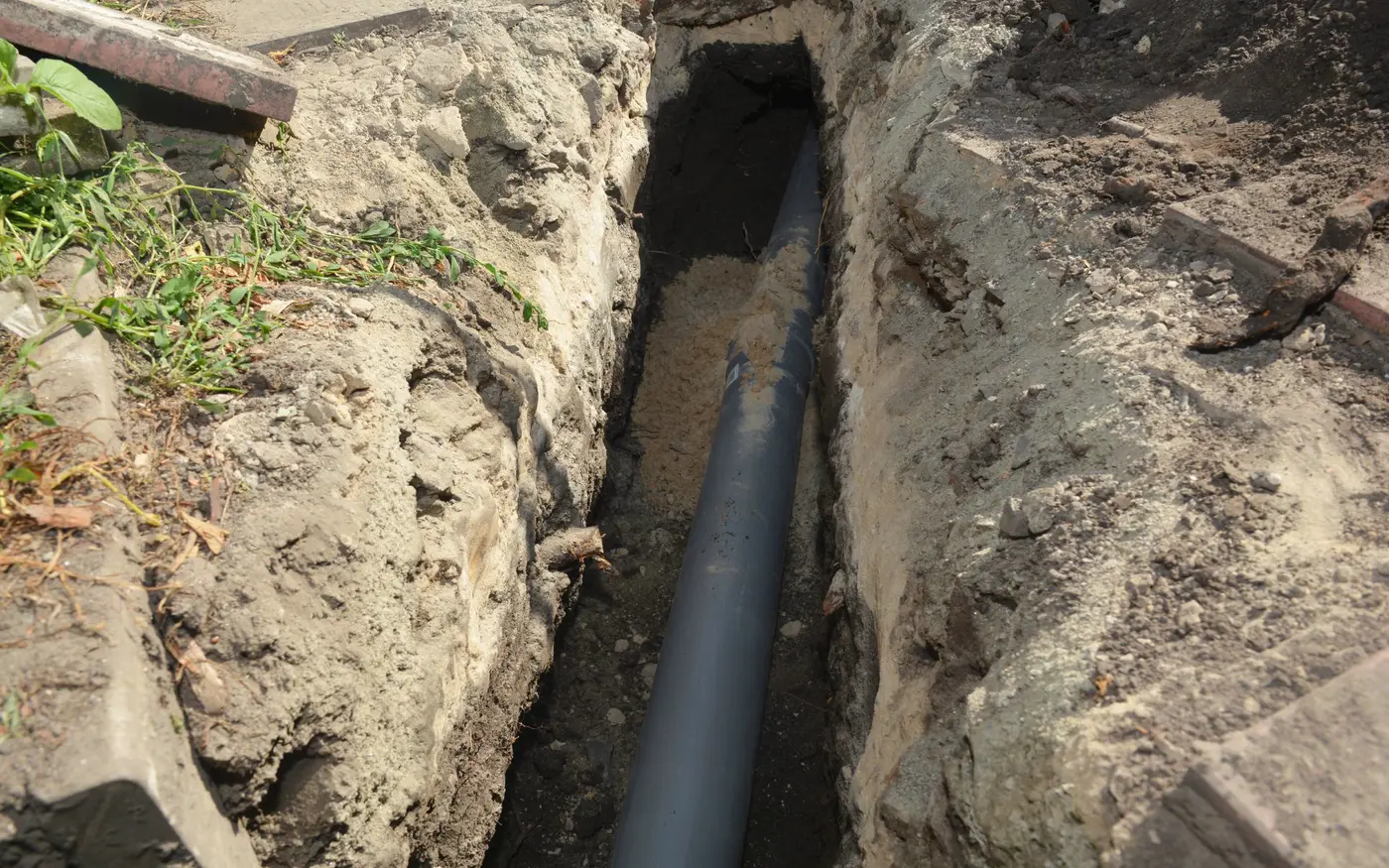
A subsoil drain collects water from within the ground and carries it away. It is a perforated pipe laid in a trench, surrounded by clean drainage aggregate and wrapped in filter cloth. Water in the surrounding soil seeps into the aggregate, enters the pipe and flows to an outlet. In New Zealand they are also called field drains, land drains or, behind a wall, drain coil.
Where subsoil drains are used
- Behind retaining walls, to relieve water pressure.
- Around foundations and basements, to keep groundwater away from the structure.
- Across wet lawns, sports fields and paddocks.
- At the toe of cut banks and slopes, to improve stability.
- Under and beside driveways and roads, to keep the base dry.
- Beneath engineered fill placed in gullies.
They are not designed to carry roof water or sudden surface flows. That is the job of sealed stormwater pipes, sumps and channels.
The parts of the system
| Component | What is used | Why |
|---|---|---|
| Pipe | Perforated or slotted pipe, commonly 65, 100 or 110 mm, flexible coil or rigid | Collects and carries the water |
| Aggregate | Clean drainage metal or scoria, about 20 to 40 mm, no fines | Lets water reach the pipe freely |
| Filter | Geotextile cloth lining the trench, or a filter sock on the pipe | Keeps silt and clay out |
| Access | Rodding points or inspection chambers at ends and bends | Allows flushing |
| Silt trap | A small sump before the outlet | Catches fines before the stormwater pipe |
| Outlet | Connection to stormwater, kerb, soakage or open drain | Gets rid of the water lawfully |
Rigid slotted pipe holds its grade better than flexible coil and is easier to flush, so it is preferred around buildings and under paving. Coil is quicker to lay and is widely used behind walls and across lawns.
Design basics
Depth
The drain can only lower the water table to about its own level. For lawns, 450 to 600 mm deep is usual. Around foundations, the drain sits at or below the level of the footing or floor it protects, without undermining it. Behind a wall, it sits at the base of the wall.
Fall
The pipe needs a continuous fall to the outlet, with no dips where silt can settle. About 1 in 100 is a good target, and 1 in 200 is commonly treated as the minimum. The trench bottom is graded with a laser or string line before the pipe goes in.
Spacing
How far a drain draws water depends on the soil. In sand or loam, one drain affects a wide strip. In clay the reach is only a few metres, so lawn systems use parallel or herringbone lines 3 to 6 metres apart. An interceptor drain, placed across a slope to catch water moving downhill, is positioned by where the seepage is, not by a spacing rule.
Outlet
Decide the outlet first. If there is nowhere lawful for the water to go by gravity, the options are a pumped sump or a different approach. In Auckland, subsoil water normally goes to the public stormwater system through a connection made by a registered drainlayer. On the volcanic isthmus it may go to soakage. It must not go to the wastewater sewer or onto a neighbouring property. The clay drainage guide lists the options.
Installation, step by step
- Locate services. Request plans through beforeUdig and find existing drains and cables on site.
- Dig the trench. Typically 300 mm wide, with the bottom cut to an even fall. See trenching.
- Line with geotextile. Cloth is laid along the bottom and up both sides, with enough spare to fold over the top.
- Bed the pipe. About 50 mm of drainage metal goes in first, then the pipe, checked for fall.
- Surround with aggregate. Metal is placed around and over the pipe, to within 100 to 150 mm of the surface for a lawn drain or the full height behind a wall.
- Close the cloth. The geotextile is folded over the top so soil cannot wash in.
- Add access points. Rodding eyes at the top end and at changes of direction.
- Connect the outlet through a silt trap.
- Backfill. Topsoil over a lawn drain. Under paving, the aggregate continues to the base course.
Why subsoil drains fail
- No filter. Clay washes into the aggregate and the pipe, and the drain blocks within a few years.
- Wrong aggregate. Metal with fines in it, or the excavated clay itself, will not pass water.
- Dips in the pipe. Silt settles in the low spots.
- No outlet, or a buried one. The drain fills and the ground stays wet.
- Tree roots. Roots follow water into slotted pipe. Keep drains away from large trees or use root barriers.
- Iron ochre. In some iron-rich groundwater a rust-coloured slime grows in the pipe. Access points for flushing are the answer.
- Smeared trench walls. Trenching in saturated clay seals the sides. Install in dry conditions.
Rules in New Zealand
The Building Code requires buildings and sitework to deal with surface water and to keep moisture out of the building. Subsoil drains that are part of building work, such as those around foundations and behind consented retaining walls, are shown on the consent drawings and inspected. Connecting any drain to the public stormwater system is work for a registered drainlayer and is controlled by the council. Field drains on lawns and farmland are generally not consented, but their outlets are still subject to the rule that water must not be discharged where it causes a nuisance or damage to someone else. Check with your council.
Cost
| Item | Guide price |
|---|---|
| Subsoil drain, installed | $90 to $200 per metre |
| Trench only, dug and backfilled | $25 to $70 per metre |
| Mini digger with operator | $95 to $130 per hour |
Guide prices for Auckland before GST, on a site with reasonable access. Only the written quote that follows a site visit is a firm figure.
At $90 to $200 per metre, a 20 metre drain behind a wall is $1,800 to $4,000, and a 60 metre herringbone system under a lawn is $5,400 to $12,000. Depth, access, the amount of aggregate and the outlet connection account for the range. The service is on the site drainage page.
Maintenance
Look at the outlet after heavy rain: clear water flowing means the drain is working. Empty the silt trap once or twice a year. Flush the line from the rodding points every few years, or sooner if flow drops. Keep the outlet clear of grass, mulch and garden waste.
Common questions
What is a subsoil drain?
A perforated pipe laid in a trench of clean drainage aggregate and wrapped in filter cloth. It collects water from saturated soil and carries it to an outlet.
How deep should a subsoil drain be?
For lawns, usually 450 to 600 mm. Around foundations and behind walls, at or below the base of what it protects. It needs a continuous fall to the outlet.
What fall does a subsoil drain need?
About 1 in 100 is a good target, and 1 in 200 is commonly treated as the minimum. The key is an even grade with no dips.
How much does subsoil drainage cost in NZ?
As a guide, $90 to $200 per metre installed, including trench, pipe, filter cloth and drainage metal. The outlet connection is extra.