In short
- Most sink holes on NZ properties come from a broken pipe washing soil away underground.
- Old septic tanks, wells, buried stumps and poor fill are the other usual causes.
- Keep people away, do not fill it blind, and find the cause first.
- The repair is to fix the cause, dig out the loose ground and backfill in compacted layers.
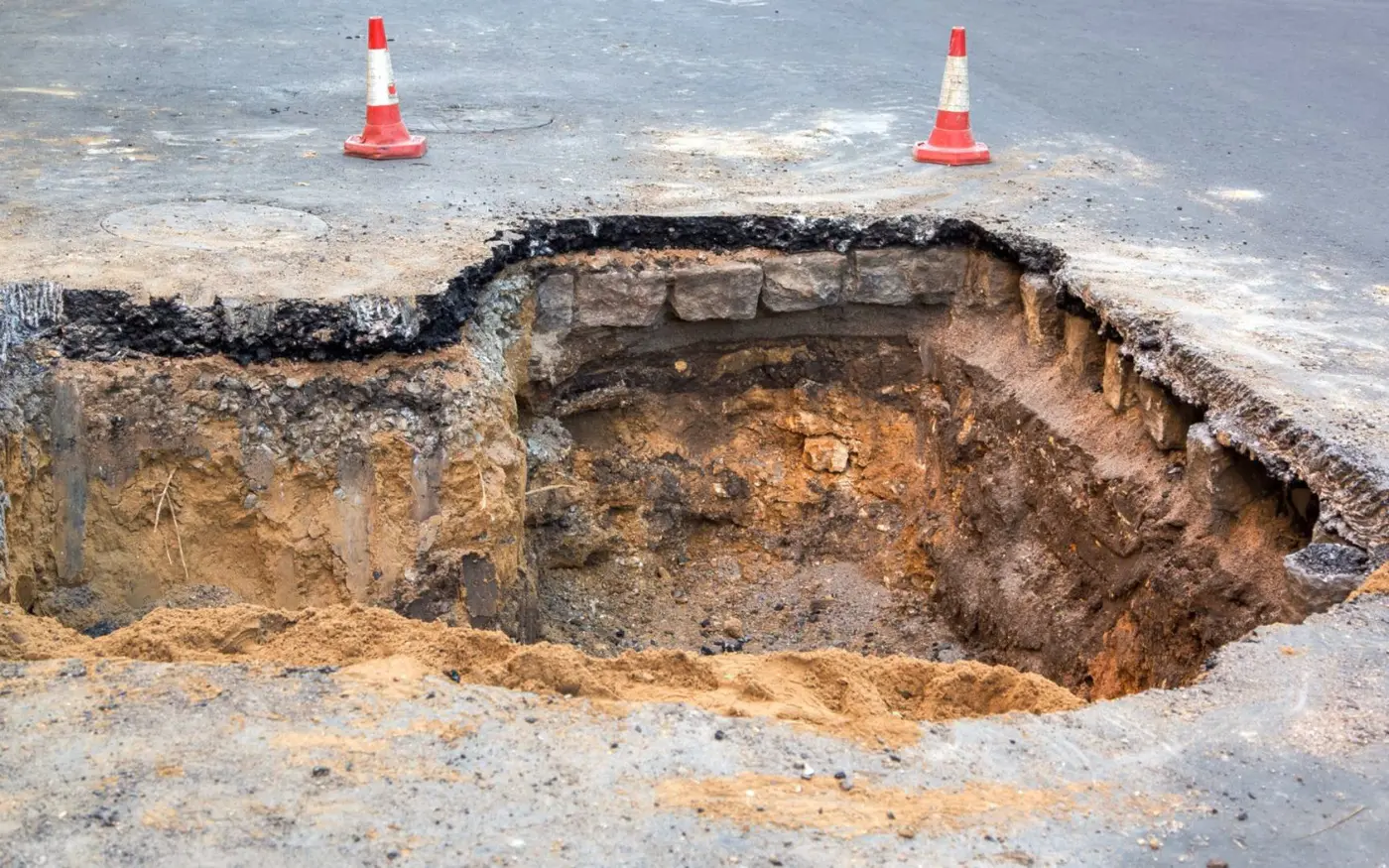
A sink hole is a hole or depression that appears when the ground surface collapses into a void beneath it. In New Zealand they are often called tomos. Natural ones form in limestone country. In towns and suburbs, nearly all of them have a man-made cause: a leaking pipe, an old tank or well, rotting buried material, or fill that was never compacted.
What causes sink holes on NZ properties
| Cause | How it forms a hole | Clues |
|---|---|---|
| Broken stormwater or sewer pipe | Soil washes into the pipe at a crack or open joint, leaving a void that grows upward | Hole is in line with a drain, appears after heavy rain |
| Leaking water main or supply pipe | Pressurised water scours the soil away | Wet ground, hissing, high water bill |
| Old septic tank, cesspool or well | The lid or lining decays and collapses | Round or rectangular hole, brick or concrete visible, older property |
| Buried stumps, timber or rubbish | Organic material rots and leaves a cavity | Site was cleared or filled, slow dishing before collapse |
| Uncompacted or eroding fill | Water moves fines through loose fill | Near retaining walls, trench lines, edges of platforms |
| Tunnel erosion | Water flows through cracks in dispersive soil and carves pipes | Hill country, holes in a line down a slope |
| Limestone or lava cavities | Natural voids collapse | Karst areas, or the Auckland volcanic field |
Pipes are the main culprit
The commonest story goes like this. An old earthenware or concrete drain cracks, or a joint opens as the ground moves. Each time it rains, water flowing past the gap draws in a little of the soil around the pipe and carries it away. Over months or years a cavity forms above the pipe and works its way up. The surface holds, bridged by roots or paving, until one day it does not. The hole that appears may be small at the top and much wider below. A collapsed sewer main opened a large hole in a street in Parnell, Auckland, in 2023, by exactly this process on a big scale.
Natural sink holes
True karst sink holes occur where slightly acidic groundwater has dissolved limestone, as around Waitomo and parts of the King Country, Northland, Hawke's Bay and Tākaka. On the Auckland isthmus, lava caves and voids exist in the basalt, and very occasionally one is exposed by excavation or collapse. These are rare next to pipe-related holes.
Warning signs
- A dip in the lawn or driveway that slowly deepens.
- Cracks in concrete forming a rough circle, or a slab that sounds hollow.
- Soil disappearing down a small hole, especially after rain.
- Fence posts, paths or garden walls tilting toward a spot.
- Drains that gurgle, block repeatedly or run muddy.
- A patch of lawn that is greener or wetter than the rest.
What to do if a hole opens
- Keep everyone back. The edges are undercut and can give way. Fence it off, well beyond the visible rim. Keep vehicles away.
- Do not climb in or probe it from the edge.
- Look for the obvious. Is it on the line of a drain? Is water running in it? Is there brickwork or a pipe visible?
- Turn off the water at the toby if a supply leak is likely.
- Call the right people. In a road, berm or footpath: Auckland Transport or the council. If a public water or wastewater pipe is involved: Watercare in Auckland. On private land: a drainlayer for a CCTV inspection of the drains, and a geotechnical engineer if the hole is large, near a building or has no obvious cause.
- Tell your insurer before repairs, and take photographs.
- Do not just fill it. Tipping soil or concrete into a hole without fixing the cause hides the problem and usually makes the eventual repair bigger.
How sink holes are repaired
- Find the cause. Drain camera survey, leak detection, property file search for old tanks and wells, and test pits.
- Fix it. Replace or reline the broken pipe, cap the leak, or pump out and remove the old tank.
- Excavate. A digger opens the hole out until all loose, wet and undermined ground is removed and the sides are in firm, undisturbed soil. This is usually much larger than the hole first looked.
- Backfill in layers. Compacted hardfill or suitable soil is placed in lifts of 150 to 200 mm, each compacted. Flowable fill or concrete is sometimes used in confined voids.
- Reinstate the surface: topsoil and grass, or basecourse and paving.
Where a building, retaining wall or driveway is affected, an engineer specifies and checks the repair. The earthworks part of the job is covered under excavation, and exposing live pipes safely is often done by hydro excavation.
What it costs
A small hole over a private drain is typically a day's work for a mini digger and operator at $850 to $1,200, plus the drainlayer's repair and hardfill at $90 to $160 per cubic metre. Holes that undermine a driveway, a wall or a building run into many thousands once engineering and reinstatement are included. The cost depends far more on the cause and what sits above than on the size of the hole.
Who pays
The owner is responsible for private drains, tanks and fill on their land, up to the point of connection with the public network. The network owner is responsible for public pipes. House insurance policies differ on gradual damage from leaking pipes and on land damage, and natural hazard cover applies only to specific natural events. Ask your insurer where you stand before starting work.
Preventing them
- Have old drains inspected by camera before buying a property or building over them.
- Fix leaking and blocked drains promptly.
- Keep large trees away from drain lines.
- Decommission old septic tanks, cesspools and wells properly: emptied, broken out or filled with compacted material, and recorded.
- Never bury stumps, timber or rubbish in fill.
- Insist that trenches and fill are compacted in layers.
Common questions
What causes a sink hole in a backyard?
Most often a cracked or broken drain pipe that lets soil wash away underground. Old septic tanks and wells, rotting buried stumps and poorly compacted fill are the other common causes.
Who do I call about a sink hole in Auckland?
For a hole in a road, berm or footpath, Auckland Transport or Auckland Council. For public water or wastewater pipes, Watercare. On private land, a drainlayer and, for large holes or holes near buildings, a geotechnical engineer.
Can I fill a sink hole myself?
Not until the cause is found and fixed. Filling over a broken pipe or void hides the problem, and the hole comes back.
What is a tomo?
A New Zealand term, from te reo Māori, for a hole or shaft in the ground. It is used for natural limestone shafts and, loosely, for any hole that opens up from subsidence.