In short
- A channel drain is a grated trench that catches water running across a driveway.
- Put it where the water is heading: in front of the garage, or at the boundary.
- Choose a load class for the vehicles that will cross it.
- Installed, a channel is $180 to $450 per metre as a guide.
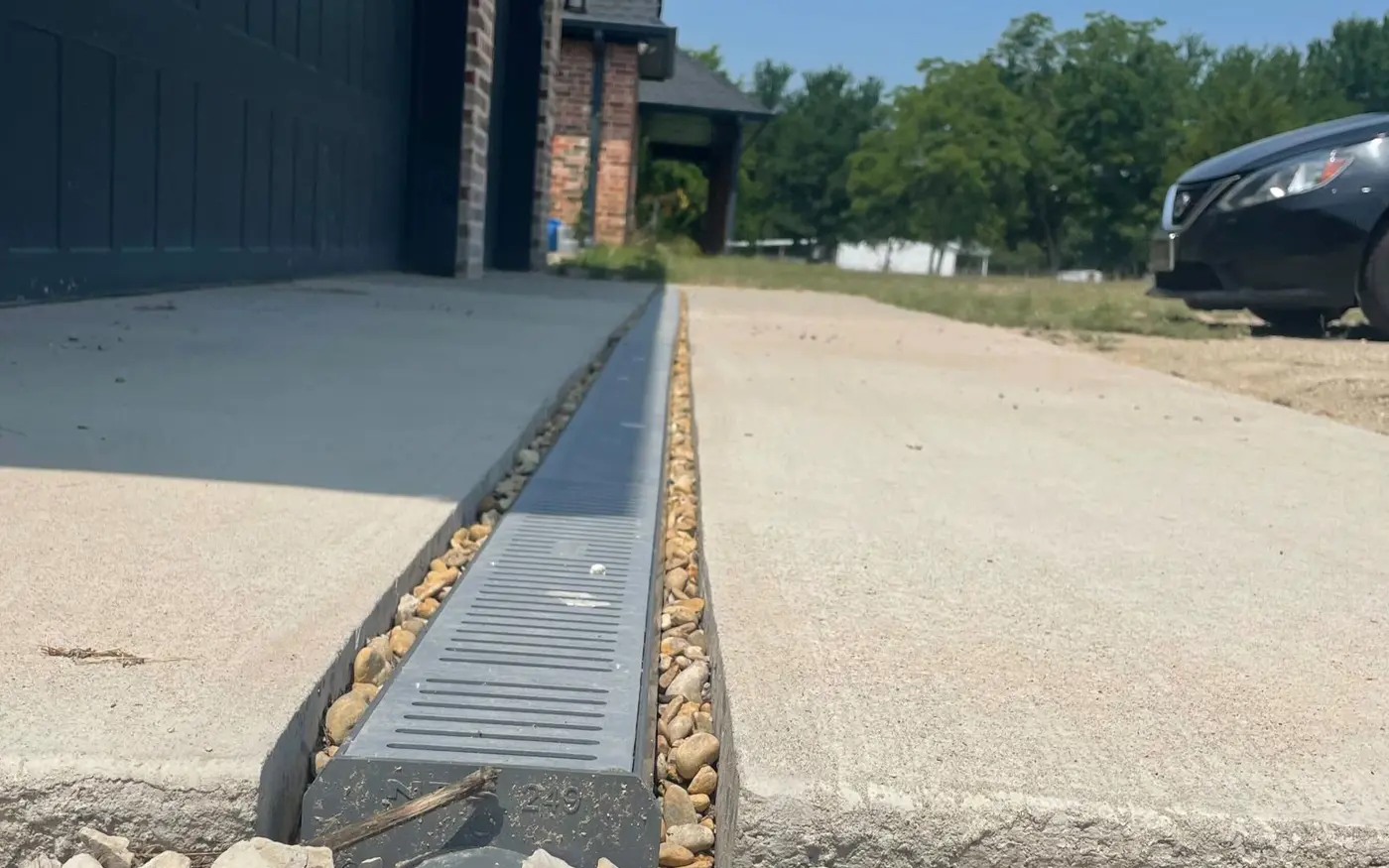
A driveway channel drain is a long, narrow trench with a grate on top, set flush with the surface so that water running across the driveway drops into it. It is also called a strip drain, trench drain or slot drain. In New Zealand it is the standard way to stop driveway runoff entering a garage or flowing out over the footpath.
When a driveway needs one
- The driveway slopes toward the garage or house. A channel across the bottom, in front of the door, is essential.
- The driveway slopes toward the street. Councils generally do not allow private runoff to sheet across the footpath, so a channel at or just inside the boundary intercepts it.
- A long or steep driveway collects enough water to cause erosion or flooding at the bottom. One or two extra channels part-way down break up the flow.
- Paved courtyards and patios hard against the house.
A driveway that falls to one side onto your own garden or lawn may not need a channel at all. A dished concrete edge or a single sump at the low point can be enough.
Types of channel
| Type | Description | Suits |
|---|---|---|
| Polymer or plastic modular channel | Lightweight sections that clip together, with plastic or galvanised grates | Car driveways, patios |
| Polymer concrete channel | Heavier precast sections with metal edge rails | Driveways with regular traffic, light trucks |
| Cast in place | Formed in the concrete slab with a steel or cast iron grate | Wide entrances, heavy vehicles |
| Slot drain | A narrow slot at the surface over a hidden pipe | Paved areas where looks matter |
Load classes
Channels and grates are sold by load class under the European standard that most suppliers here follow.
| Class | Rated for | Use |
|---|---|---|
| A15 | Pedestrians and cycles | Paths and patios only |
| B125 | Cars and light vehicles | Most house driveways |
| C250 | Slow-moving heavier vehicles | Shared driveways, delivery and rubbish trucks |
| D400 | Trucks and road traffic | Commercial yards and entrances |
A pedestrian-rated channel across a driveway will crack the first time a courier van crosses it. If a rubbish truck, a concrete truck or a moving truck will ever use the driveway, go up a class.
Sizing
The channel has to carry the peak flow from the area that drains to it. That depends on the catchment area, the local design rainfall and the fall of the channel. For a standard two-car driveway, a channel 100 mm wide inside is common. Long, steep or large driveways need a wider or deeper channel, more than one outlet, or an intermediate channel. The outlet pipe matters as much as the channel: a 100 mm channel emptying through a small pipe will back up. Where runoff is significant, a drainlayer or engineer should size it using the council's rainfall figures.
Installation
- Set the line and level. The grate finishes 2 to 5 mm below the surrounding surface so water falls in and tyres do not catch the edge.
- Excavate a trench wide and deep enough for the channel plus a concrete surround, typically 100 mm on each side and beneath.
- Lay the outlet pipe from the channel to the stormwater connection, with fall.
- Bed the channel in concrete, working uphill from the outlet. Sections are joined and sealed.
- Haunch both sides with concrete. This is what carries the wheel load. A channel sitting on gravel with pavers butted against it will move.
- Fit the grates and lock them down.
- Finish the driveway surface up to the channel with an expansion joint where it meets a concrete slab.
In a new driveway the channel goes in with the base preparation. See driveway digout depth. Retrofitting one means saw-cutting the existing concrete.
Where the water goes
The channel connects to the property's stormwater drain, usually through a sump or silt trap so leaves and grit do not block the pipe. That connection is drainlaying work and normally needs a registered drainlayer and a building consent. Where there is no stormwater system, the options are a kerb outlet if the council allows one, or soakage where the ground suits. A channel must never be connected to the wastewater sewer or a gully trap. Adding a large area of new sealed driveway can trigger stormwater rules in some zones, so check with Auckland Council.
Cost
| Item | Guide price |
|---|---|
| Channel drain supplied and installed | $180 to $450 per metre |
| Trench for the outlet pipe | $25 to $70 per metre |
| Driveway digout and base, if new | $45 to $95 per m² |
Guide prices for Auckland before GST, on a site with reasonable access. Only the written quote that follows a site visit is a firm figure.
A 5 metre channel across a double garage door comes to $900 to $2,250 as a guide. The low end is a light-duty channel set into a new driveway. The high end is a heavy-duty channel cut into existing concrete. The outlet pipe and its connection are on top. See the site drainage page and driveway excavation.
Maintenance
- Lift the grates and scoop out leaves, silt and gravel every few months, and before winter.
- Empty the sump or silt trap at the outlet.
- Flush the channel and outlet pipe with a hose.
- Replace cracked or missing grates promptly. An open channel is a trip and tyre hazard.
- If water ponds beside the channel instead of entering it, the surface has settled or the grate is blocked.
Common questions
Do I need a channel drain across my driveway?
If the driveway slopes toward the garage or house, yes. If it slopes to the street, usually yes at the boundary, because runoff should not flow across the footpath. Driveways that fall onto your own lawn may not need one.
What size channel drain for a driveway?
A 100 mm wide channel suits most two-car driveways. Larger, longer or steeper driveways need a bigger channel or more than one. Use a load class of at least B125 for cars.
Where does a driveway channel drain to?
To the stormwater system through a sump or silt trap, connected by a registered drainlayer. Not to the wastewater sewer or a gully trap.
How much does a driveway channel drain cost in NZ?
As a guide, $180 to $450 per metre supplied and installed, plus the outlet pipe and connection.