In short
- In NZ, cesspit usually means a stormwater catchpit: a grated sump that traps silt.
- It collects runoff, lets grit settle and sends cleaner water down the pipe.
- Private cesspits are the owner's job to clean. Street ones belong to Auckland Transport.
- Old sewage cesspools still turn up on rural and pre-sewer properties and must be dealt with properly.
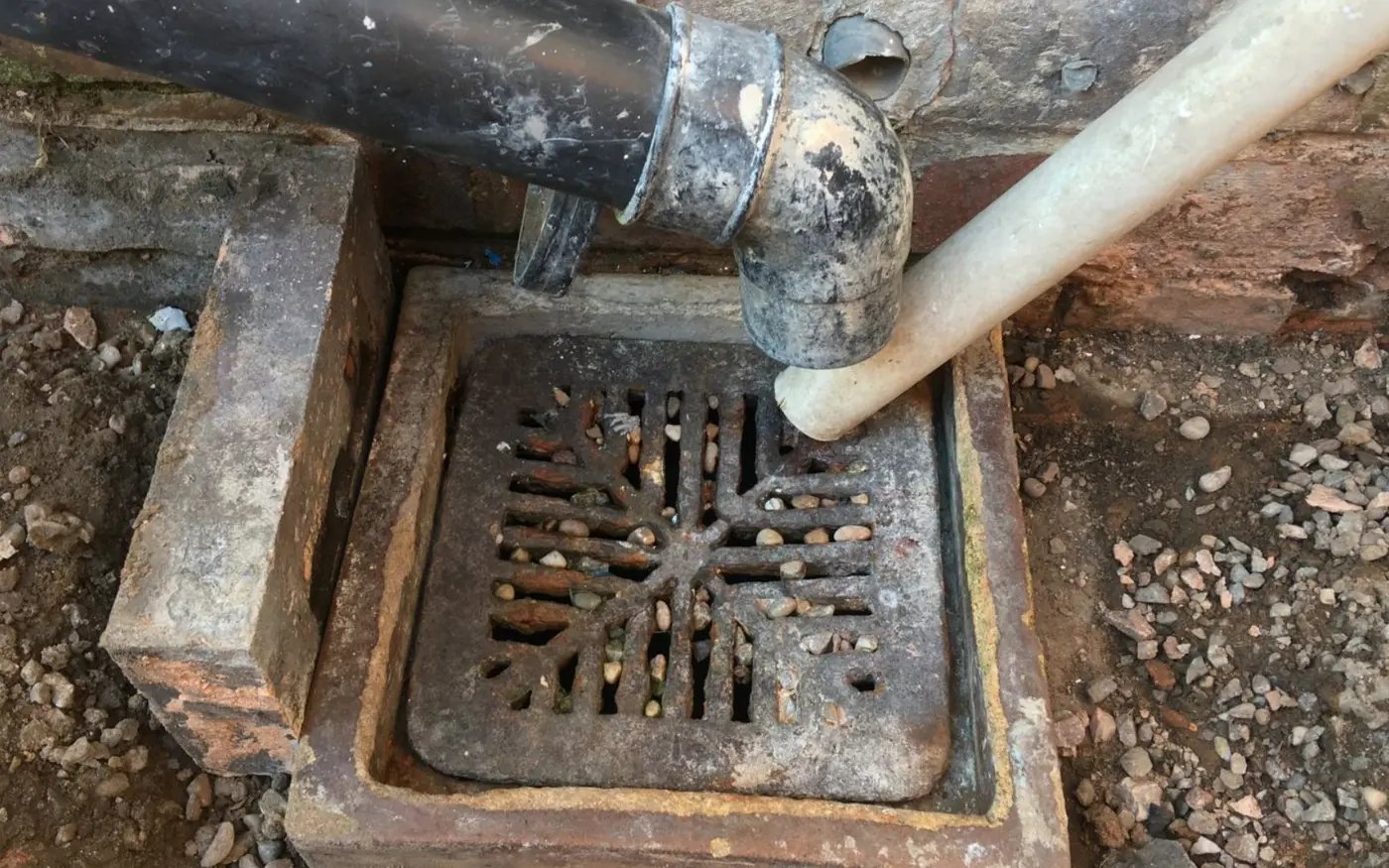
In New Zealand the word cesspit usually means a stormwater catchpit: a chamber in the ground with a grate on top, found at the low point of a driveway, car park or road. Water runs in through the grate, grit and leaves settle in the bottom, and the water leaves through an outlet pipe set part-way up the wall. The older meaning, a pit that holds sewage, still applies to some old rural properties.
Two meanings, two systems
| Stormwater cesspit (catchpit, sump) | Sewage cesspit (cesspool) | |
|---|---|---|
| Receives | Rainwater runoff from paving and roads | Household wastewater |
| Part of | The stormwater system | An on-site wastewater system |
| Where found | Driveways, yards, kerbs, car parks | Old rural and pre-sewer properties |
| Status today | Standard, required practice | Obsolete, not permitted for new work |
Most of this guide is about the stormwater kind, because that is what people are usually asking about when a contractor mentions putting in a cesspit.
How a stormwater cesspit works
A catchpit is a simple settling device.
- Runoff carrying silt, sand, leaves and litter flows in through the grate.
- Inside the chamber the water slows, and heavy material sinks into the sump, the part of the chamber below the outlet pipe.
- Water rises to the outlet and flows away to the stormwater drain.
- On many cesspits the outlet is fitted with a downturned bend or baffle, so floating litter and oil stay in the chamber instead of going down the pipe.
Without a sump, grit goes straight into the pipes, settles in them and blocks them where it cannot easily be reached.
Where they are used on a property
- At the low point of a driveway or parking area.
- At the end of a channel drain, as the silt trap before the stormwater connection.
- In a lawn or garden hollow that collects water.
- At the outlet end of a subsoil drain.
- In yards, wash-down areas and commercial hardstand, sometimes with extra treatment devices.
Types and sizes
- Small plastic or polymer sumps, 300 to 450 mm square, for domestic paving and gardens.
- Precast concrete cesspits, commonly 450 by 675 mm or larger, with cast iron or steel grates, for driveways and anywhere vehicles cross.
- Road cesspits with kerb back-entries, built to the road authority's standard.
As with channel drains, the grate and frame are chosen by load class: light-duty for foot traffic, heavier for cars, heavier again for trucks. The sump should be deep enough to hold several months of silt, typically 300 mm or more below the outlet.
Installation
- Position. At the true low point, confirmed with a level, where the paving falls to it from all sides.
- Excavate a hole larger than the chamber, deep enough for a compacted base. See digouts.
- Base. A bed of compacted hardfill or concrete so the chamber cannot settle.
- Set the chamber level, with the grate finishing just below the surrounding surface.
- Connect the outlet pipe with fall to the stormwater drain. This connection is drainlaying work.
- Backfill in layers with compacted hardfill, and haunch with concrete under driveways.
- Finish the surface so it falls evenly to the grate.
The digging and backfilling are earthworks. Connecting to the public stormwater system is restricted to registered drainlayers and normally needs a building consent. In Auckland, new or changed connections also need the council's approval.
Cleaning and maintenance
A cesspit that is full of silt does nothing. Worse, it becomes a plug: water ponds on the driveway and the first big storm floods the garage.
- Inspect every few months and after storms. Lift the grate and look at how much sediment is in the bottom.
- Clean when the sump is about half full. Small domestic sumps can be dug out by hand with a trowel and bucket. Larger ones are emptied by a vacuum truck, the same kind used for hydro excavation.
- Dispose of the sludge properly. It contains oil, heavy metals and litter from the paving, and should go in the rubbish or to a waste facility, not onto the garden or down the drain.
- Check the grate, frame and any outlet baffle are intact.
Who is responsible
Cesspits on private land, including shared driveways and private roads, belong to the property owners, who share the cost on a shared access. Cesspits in public roads are maintained by the road controlling authority, which in Auckland is Auckland Transport. A blocked street cesspit can be reported to the council or Auckland Transport. Do not sweep or hose leaves, soil or concrete slurry into any cesspit: everything that goes in ends up in a stream or the harbour, and during building work inlet protection is part of sediment control.
Old sewage cesspits and cesspools
Before sewers and modern septic tanks, many houses drained to a cesspool: an unlined or brick-lined pit where sewage soaked into the ground. They were common on rural properties and in suburbs that were sewered late. They are no longer permitted for new work. On-site wastewater now has to be treated in a septic tank or treatment plant with a designed disposal field, and in Auckland those systems are regulated by the council.
Old cesspools matter to earthworks because they are still there. A digger opening up a back yard on an older property sometimes breaks through into a void, a brick chamber or a pit of black sludge. They are a collapse hazard, the contents are contaminated, and they cannot be left under a new building or driveway. The usual treatment is to pump out and remove the contents to a licensed facility, break out the structure, and backfill with compacted hardfill under an engineer's direction if anything will be built over it. An unexplained dip or soft patch in an old lawn is sometimes the first sign of one: see sink holes.
Cost pointers
A small domestic sump is an inexpensive item, and most of the cost is the digging, the outlet pipe and the drainlayer's connection. Trenching for the outlet is $25 to $70 per metre as a guide, and a mini digger with an operator is $95 to $130 an hour. A vacuum truck for cleaning larger cesspits is $250 to $400 an hour. The site drainage page covers the service.
Common questions
What is a cesspit in NZ?
Usually a stormwater catchpit: a grated chamber at a low point in a driveway or road that collects runoff, traps silt in its sump and passes the water to the stormwater drain.
How often should a cesspit be cleaned?
Check it every few months and clean it when the sump is about half full of silt. Many domestic sumps need emptying once or twice a year.
Who is responsible for cleaning a cesspit?
The owner, for cesspits on private land and shared driveways. Cesspits in public roads are maintained by the road authority, Auckland Transport in Auckland.
Is a cesspit the same as a septic tank?
No. In modern NZ usage a cesspit is a stormwater sump. A septic tank treats household wastewater. Old sewage cesspools were simple soak pits and are no longer permitted.