In short
- Timber walls up to 1.5 m cost $350 to $600 per m² of wall face, built and drained.
- Concrete sleeper and block walls cost $550 to $950 per m².
- Height, access and ground conditions change the price more than the material.
- Over 1.5 m, or with a load on top, add $1,500 to $4,000 for an engineer and $2,500 to $6,000 for consent.
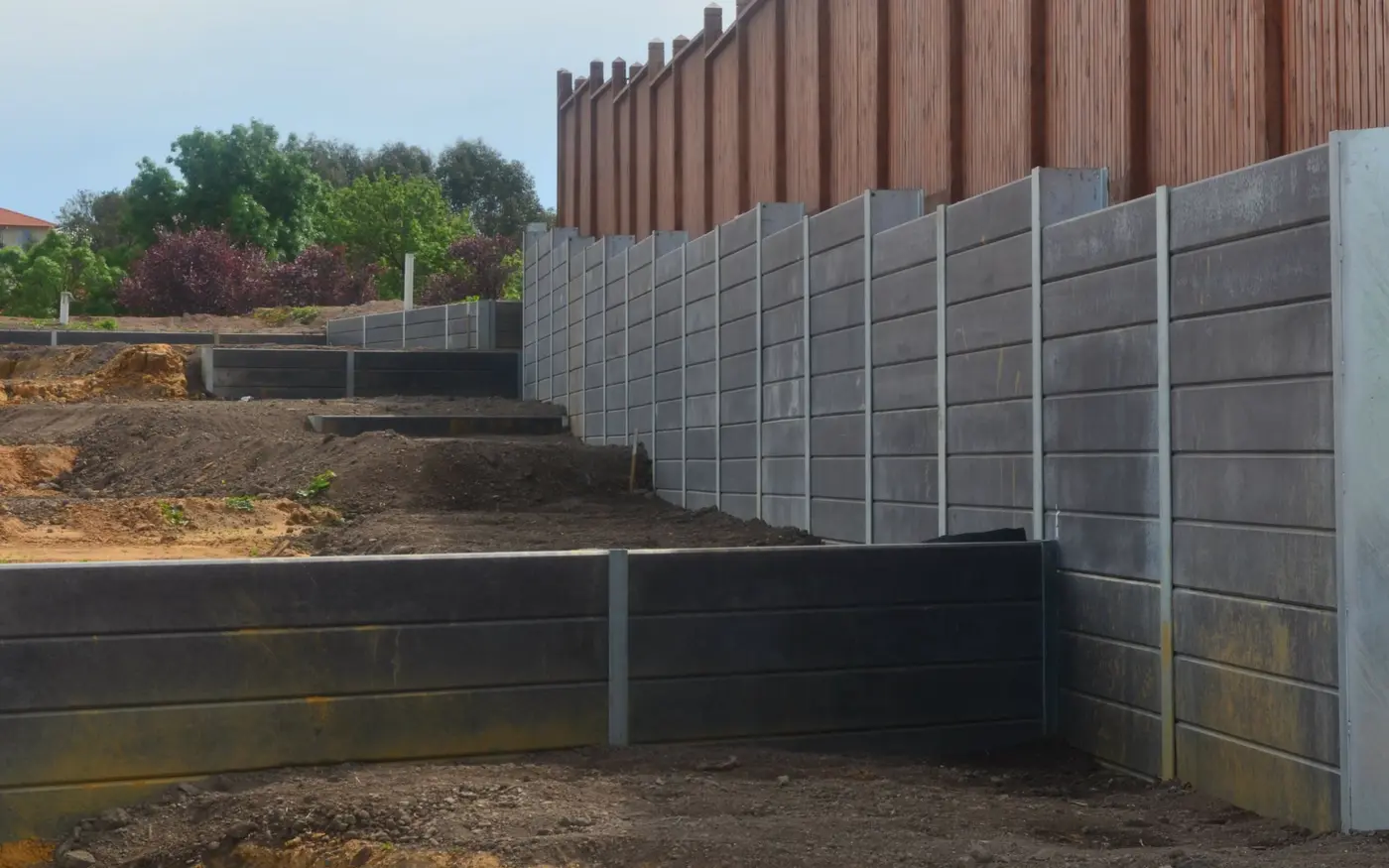
In New Zealand a retaining wall costs from $350 to $600 per square metre of wall face for treated timber up to 1.5 metres high, to $550 to $950 for concrete sleeper or masonry block. Those figures are for a finished wall including drainage. Excavation, cartage of spoil, engineering and consent fees are extra where they apply.
Cost per square metre by wall type
| Wall type | Guide price per m² | Typical life |
|---|---|---|
| Treated timber pole and rail, up to 1.5 m | $350 to $600 | 20 to 40 years |
| Engineered timber, over 1.5 m | $600 to $950 | 20 to 40 years |
| Keystone-style segmental block | $500 to $850 | 50 years plus |
| Concrete sleeper or masonry block | $550 to $950 | 50 years plus |
| Gabion baskets | $400 to $750 | 50 years plus |
| Rock wall placed by digger | $350 to $700 | Indefinite |
Guide prices per square metre of wall face, built and drained, before GST, on a site with reasonable access.
How to measure your wall
Wall face area is length multiplied by height, where height is from the ground in front of the wall to the top. A wall that steps or tapers is measured in sections. The part of the wall below ground, the posts or footing, is not counted in the area but is allowed for in the rate.
Worked examples
A garden wall, 12 m long and 1 m high
That is 12 square metres. In timber at $350 to $600 it comes to $4,200 to $7,200. In concrete sleepers at $550 to $950 it is $6,600 to $11,400.
A boundary wall, 20 m long and 1.4 m high
28 square metres. Timber: $9,800 to $16,800. Keystone-style block at $500 to $850: $14,000 to $23,800.
A driveway wall, 15 m long and 2 m high
30 square metres, over 1.5 metres and carrying vehicle load, so it is an engineered wall with a building consent. Engineered timber at $600 to $950 is $18,000 to $28,500. Add $1,500 to $4,000 for the design and $2,500 to $6,000 for consent fees.
Why taller walls cost more per square metre
The force on a retaining wall rises much faster than its height. Double the height and the push from the soil roughly quadruples. So a 2 metre wall needs far deeper posts or a bigger footing, heavier members and often closer spacing than a 1 metre wall. On top of that come the engineer's design, inspections and consent. Two 1 metre walls stepped up a slope can be cheaper than one 2 metre wall, provided they are far enough apart that the upper one does not load the lower. An engineer should confirm the spacing.
What else moves the price
- Access. If a digger with an auger can drive along the wall line, post holes take minutes each. If poles and concrete are carried down a bank by hand, labour doubles.
- The cut. A wall needs room behind it for drainage. Cutting the bank back, and trucking away what does not go back as backfill, is earthworks priced at $25 to $60 and $45 to $110 per cubic metre.
- Ground. Rock means slow drilling. Soft or wet ground means deeper posts.
- Load on top. A driveway, a building, a pool or a steep slope above the wall is a surcharge, and the wall must be designed for it.
- Removing an old wall. Pulling out and disposing of the existing wall comes first.
- Finish. Capping, staining, a fence on top, steps and planting.
The costs people forget
| Item | Guide cost | When it applies |
|---|---|---|
| Engineer's design and producer statement | $1,500 to $4,000 | Walls over 1.5 m or with surcharge |
| Building consent fees | $2,500 to $6,000 | Same |
| Geotechnical report | $2,500 to $5,000 | Slopes, poor ground, coastal sites |
| Resource consent | $4,000 to $12,000 | Some zones, overlays and volumes |
| Fence or barrier on top | Priced separately | Where someone could fall 1 m or more |
Is a cheaper wall a false economy?
The parts of a wall you cannot see are where money gets saved badly. Posts that are too shallow, timber treated for fences instead of ground contact, and backfill of clay with no drain all lower a quote, and each one shortens the wall's life. A timber wall built properly should last decades. One built without drainage in Auckland clay often leans within ten years, and replacing it costs more than the original because the old wall has to come out first. When comparing quotes, ask each contractor for post depth, timber treatment, and the drainage detail in writing.
Timber or concrete over the long run?
Timber is roughly two-thirds the price of concrete sleepers. Concrete should last at least twice as long. For a low garden wall that is easy to reach, timber is good value. For a boundary wall with a fence, a driveway or a building close behind it, where replacement would be difficult and expensive, concrete usually wins over the life of the wall. The timber wall guide and the Keystone wall guide go into each type.
Consent in brief
A retaining wall does not need a building consent if it retains no more than 1.5 metres of ground and supports no surcharge. Anything taller or loaded needs a consent and specific engineering design. The wall and its earthworks may also need a resource consent, depending on the district plan. In Auckland, check the property on GeoMaps and confirm with the council.
Walls in Auckland are covered on the retaining walls page.
Common questions
How much does a retaining wall cost per m² in NZ?
As a guide, $350 to $600 for treated timber up to 1.5 metres, $500 to $850 for Keystone-style block, $550 to $950 for concrete sleeper or masonry block and $400 to $750 for gabions, per square metre of wall face, built and drained.
Which retaining wall is cheapest to build?
Treated timber pole and rail is usually the cheapest built wall. Where a digger has access and rock is available, a stacked rock wall can cost about the same.
How much does a 1 metre high retaining wall cost?
At $350 to $600 per square metre, a timber wall 1 metre high costs that much per metre of length. A 10 metre wall is $3,500 to $6,000.
When does a retaining wall need an engineer?
For walls retaining more than 1.5 metres, walls with a driveway, building or slope above them, and walls on unstable ground, yes.