In short
- Find where and why it leaks before choosing a repair.
- Repairs are made from the inside, where water pressure pushes the patch on, not off.
- A fitted liner is $2,500 to $6,000 as a guide and suits tanks with many cracks.
- Never enter a tank alone. It is a confined space.
A leaking concrete water tank can usually be repaired. Fine cracks and porous patches are sealed from the inside with a coating made for drinking water. Wider or moving cracks are filled with a flexible sealant or injected. Tanks with many cracks are fitted with a liner. Tanks whose walls or floor have failed structurally are replaced. The first step is working out which of those you have.
Why concrete tanks leak
- Uneven support. A tank holds a tonne for every thousand litres. If part of the base settles, washes out or sits on soft fill, the floor cracks. This is the commonest serious cause.
- Tree roots lifting or pushing the base and walls.
- Ground movement: clay shrinking and swelling, earthquakes, slips, or vehicles driven too close.
- Corroding reinforcing. Where steel is close to the surface, rust expands and breaks off the concrete.
- Construction joints. The joint between floor and wall, and around pipe fittings, is a weak point.
- Age. Soft rainwater slowly dissolves lime from the concrete surface and leaves it porous.
- Running dry. A tank left empty in summer dries and cracks.
Find the leak
Damp patches or white mineral streaks on the outside show where water is coming through. A crack you can see outside almost always goes right through. If the level drops but nothing shows on the walls, suspect the floor, the floor-to-wall joint, or the outlet fitting and pipework: check taps, valves and the pump first, since those are easy fixes. Marking the water level and watching where it stops falling tells you the height of the leak.
Repair options
| Method | Suits | Notes |
|---|---|---|
| Leave to self-seal | Hairline cracks that weep | Lime in the concrete can seal very fine cracks over weeks if the tank stays full |
| Flexible sealant in a chased crack | Individual cracks up to a few millimetres | Crack is ground out to a groove, primed and filled from inside |
| Crack injection | Structural cracks in otherwise sound walls | Epoxy or polyurethane injected under pressure by a specialist |
| Cementitious or epoxy coating | Porous walls, many fine cracks | Brushed or sprayed over the whole interior |
| Tank liner | Widespread cracking, old tanks | A made-to-measure flexible liner, $2,500 to $6,000 fitted |
| Replacement | Failed floor, spalling, unstable base | New 25,000 litre plastic tank on a prepared pad, $4,000 to $9,000 |
Guide prices before GST. Tank size, access and condition change them.
Why repairs are done from the inside
Water inside the tank presses outward. A patch on the inside face is pushed against the concrete by that pressure. A patch on the outside is pushed off. External repairs with mortar or sealant nearly always fail within a season. The inside is where the work happens, which means draining the tank.
Use products approved for drinking water
If the tank supplies the house, anything applied inside must be certified for contact with potable water, normally to the standard AS/NZS 4020. Ordinary bitumen paints, roofing sealants and general-purpose fillers are not suitable.
The repair process
- Arrange another water supply or time the job for when a tanker refill is easy.
- Drain and clean the tank. Sludge is removed, and walls and floor are water-blasted.
- Let it dry as far as the product requires.
- Prepare cracks: grind out, remove loose concrete, treat exposed steel.
- Fill cracks and coat, or fit the liner.
- Cure for the time the manufacturer specifies before refilling.
- Refill, check and disinfect before using the water for drinking.
Safety: a tank is a confined space
People have died in water tanks. The air inside can be short of oxygen or contain fumes from coatings and petrol-driven equipment, and a person who collapses inside is very hard to get out. Never enter a tank alone, never use an engine or solvent-based product inside without forced ventilation, and have someone outside at the hatch the whole time. Professional tank repairers work under confined space procedures with gas monitors and rescue gear. For most owners, this is the reason to hire the job out.
When to replace instead
- The floor has cracked across and one side has dropped.
- Concrete is flaking off in sheets and steel is exposed and rusting through.
- The roof is unsafe.
- The tank is tilting, or the ground under it has washed out.
- The repair quote approaches the cost of a new tank.
A tank that leaked because its base failed will crack again after a wall repair unless the support is fixed.
Where earthworks come in
Tank repair itself is specialist work, and it is not something arranged through this site. Earthworks become part of the picture when a tank is replaced or its base has to be put right.
- Removing the old tank. A concrete tank is broken up with a digger and breaker, and the rubble is carted to a concrete recycler. See demolition.
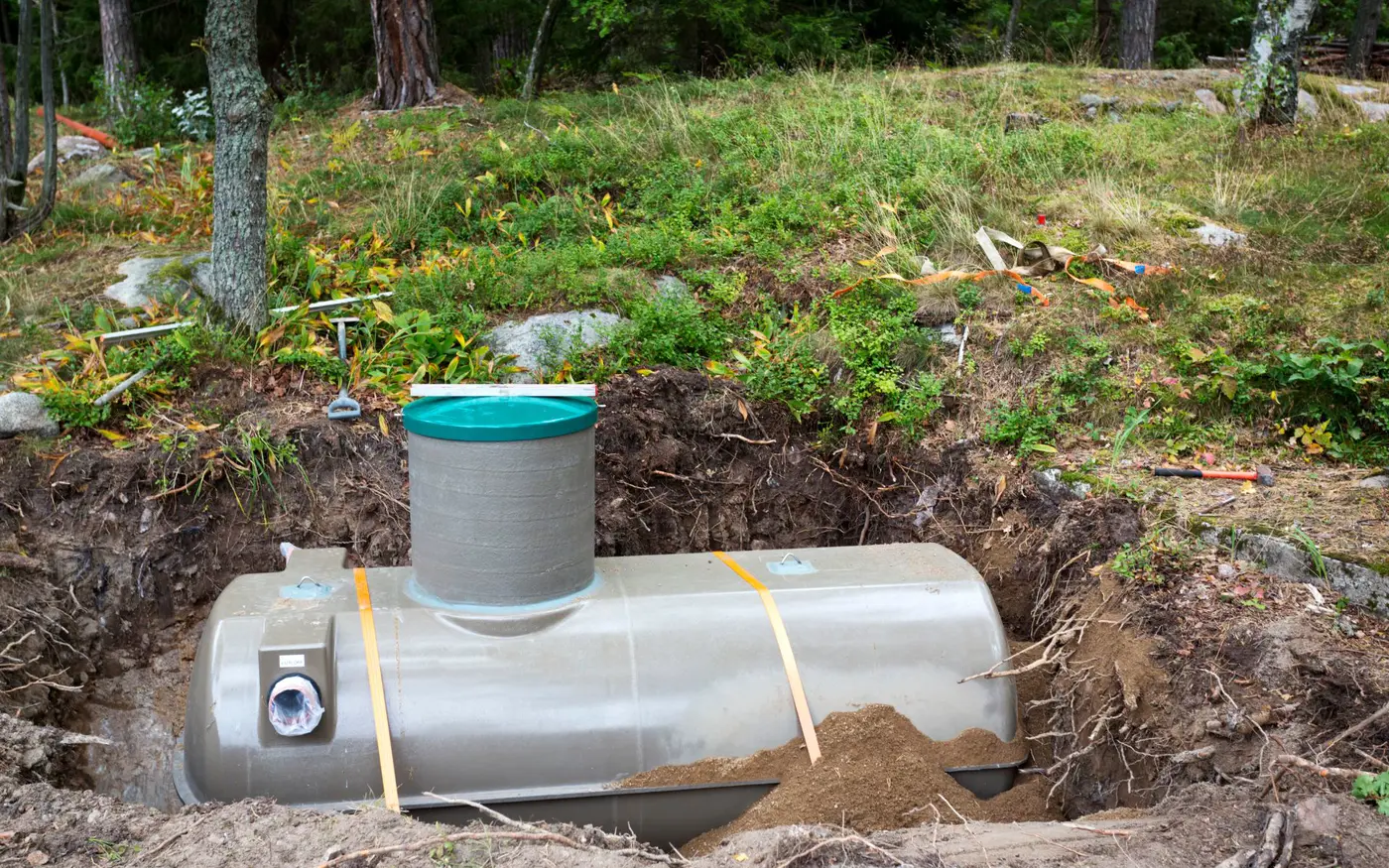
- Preparing the pad. A new tank needs a level, firm, evenly compacted base wider than the tank, free of stones, usually compacted hardfill finished with sand, following the tank maker's instructions. A pad is $1,500 to $4,500 as a guide.
- Cut sites. A pad cut into a slope needs the cut retained or battered, and the tank must not sit half on cut and half on fill.
- Drainage. Overflow water is piped away so it cannot scour the pad. On clay, a subsoil drain on the uphill side keeps the base dry.
- Trenches for the supply and overflow pipes. See trenching.
Large tanks, tanks on stands and tanks close to boundaries can need a building consent, and district plans have rules on their position. Check with your council.
Keeping a repaired tank sound
- Keep it at least partly full all year.
- Keep trees and vehicles away from it.
- Direct overflow and surface water away from the base.
- Clean it out every few years, and inspect the inside when you do.
- Screen inlets and keep gutters clean to reduce sludge.
Common questions
Can a cracked concrete water tank be repaired?
Usually. Fine cracks are sealed from the inside with a potable-rated sealant or coating, and tanks with widespread cracking are fitted with a liner. Tanks with a failed floor or base are replaced.
Can I patch a concrete tank from the outside?
It rarely lasts. Water pressure pushes an outside patch off. Lasting repairs are made on the inside face.
How much does it cost to line a concrete water tank?
As a guide, $2,500 to $6,000 fitted, depending on the size and shape of the tank and how much preparation it needs.
Is it safe to go inside a water tank?
Only with proper precautions. A tank is a confined space with a risk of low oxygen and fumes. Never enter alone, and leave coatings work to people equipped for it.